42km, Two Countries, Zero Signal: What a Solo Trail Run Taught Me About Digital Health in Europe
A nurse and digital health student runs solo from Schaffhausen to Donaueschingen and discovers what dead zones reveal about Europe's connected health ambitions.
42 km
Total Distance
2
Countries
Solo
No Support Crew
~0%
Mobile Data
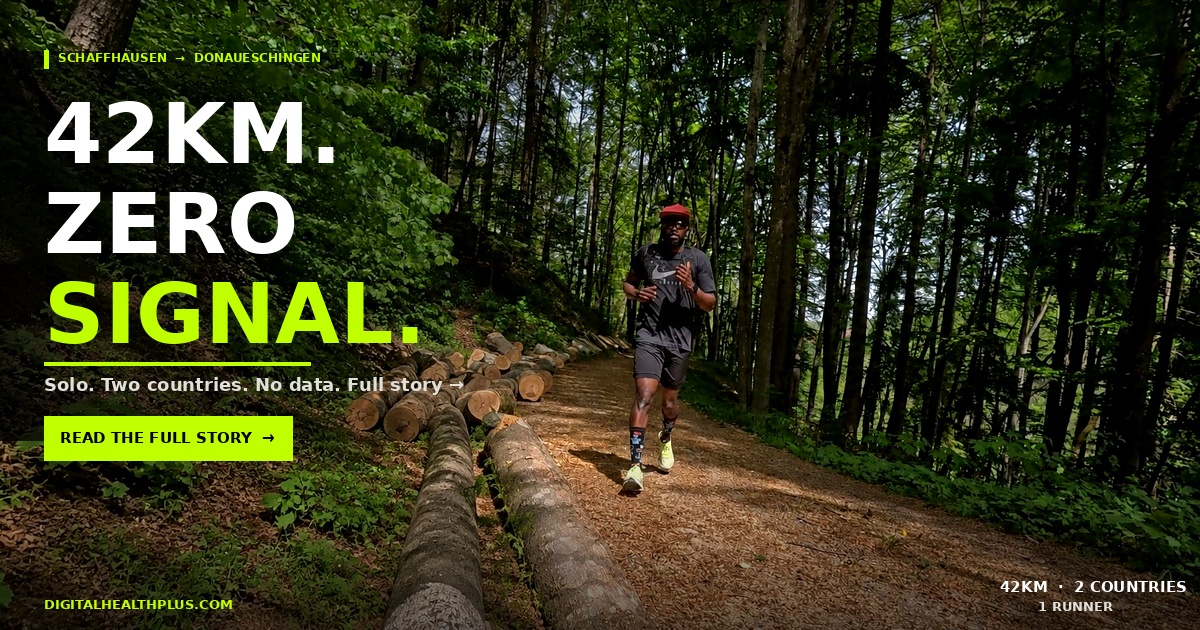
On 3 May 2026 I ran a 42km solo trail from Schaffhausen (Switzerland) to Donaueschingen (Germany) — a route with no direct train connection, almost no documented running reports online, and, as I quickly discovered, almost no mobile signal either. What started as a personal goal became one of the most thought-provoking experiences of my year — not just as a runner, but as a registered nurse and founder of Digital Health Plus.
This is the story of that run. It's also a question I haven't been able to shake since: how can Europe build a credible digital health future when internet connectivity still disappears the moment you leave a city?
The Route: Schaffhausen to Donaueschingen on Foot
There is no obvious reason to link these two towns by trail. No guidebook does it, no Strava segment connects them end-to-end, and no direct train exists between them. That invisibility was exactly the appeal. I started at Schaffhausen Altstadt at 10am and navigated north-east through Merishausen and Bargen in Switzerland, across the border into Germany, and through Blumberg before the final push to Donaueschingen.
The terrain is varied and genuinely beautiful: open farmland, forest sections, and rolling hills. The early Swiss section is popular with cyclists of all ages — a reliable sign that the trail infrastructure is solid, even if it's underrepresented online for runners.
Kit List: What I Actually Carried for 42km Solo
I run lean. No hydration vest stuffed with gadgets, no support crew in a van with protein shakes. My kit was minimal by design:
- Snacks and smoked fish — real food, not gels. Practical, calorie-dense, and no packaging waste.
- 1-litre water bottle — refilled freely at the many public drinking wells along the Swiss section. Cross into Germany and most wells are non-potable, so plan to buy water.
- GoPro Hero 13 — to document the route. Compact, rugged, and one of the few pieces of kit that genuinely earns its weight.
- Samsung Galaxy Watch 8 (2025) 40mm — the technology that held the entire run together. More on this below.
Why the Samsung Galaxy Watch 8 Matters on a Remote Solo Run
On a solo effort of this distance — through genuinely remote stretches where trail markers thin and the countryside blurs between two countries — real-time biometric feedback is not optional. The Samsung Galaxy Watch 8 (2025) 40mm brought heart rate tracking, running coach guidance, energy score, and sleep coaching into one compact device — without ever needing a mobile signal to do its job.
Heart rate zones kept me from blowing up on the climbs. Pace data helped me bank time before the late morning heat arrived. And crucially, the watch required no mobile data — it worked entirely from onboard sensors, logging everything locally and syncing when connectivity eventually returned.
"The watch never let me down. In the absence of everything else digital, it was the one piece of technology that quietly did exactly what it promised."
As an Amazon Associate, I earn from qualifying purchases — at no extra cost to you.
No Signal in the Heart of Europe: A Digital Health Problem
My phone runs dual SIMs — neither loaded with data. Even if they had been, it would have made little difference. Apart from a faint WLAN signal in parts of Schaffhausen's old town at the start, I was offline for the vast majority of those 42 kilometres.
Switzerland has some of the most expensive international roaming costs in Europe — a genuine financial barrier for visitors, travellers, and patients in cross-border care arrangements. Rural Germany, meanwhile, has well-documented mobile coverage gaps that remain stubbornly present in areas like the Black Forest borderlands I was running through.
"We talk endlessly about Europe's digital health future — remote monitoring, connected devices, AI diagnostics — but all of it rests on a single assumption we rarely question: that there is a signal."
Strava Isn't Just a Fitness App — It's a Safety Tool
Most people think of Strava as the place you post your splits and collect kudos. But on a solo trail run through remote terrain, it functions as something more significant: a live location relay. When you're running with signal, friends and family can see your GPS dot in real time. If that dot stops in an unusual place, someone notices. In a genuine emergency — a fall, a cardiac event, severe heat exhaustion — that ambient monitoring could be the difference between a timely rescue and a far worse outcome.
🏥 Clinical Perspective
Fitness tracking apps like Strava function as passive safety infrastructure in remote environments. Live location sharing provides ambient monitoring without requiring the runner to take any action — but only when mobile connectivity is available. In dead zones, that safety layer disappears entirely.
On my run from Schaffhausen to Donaueschingen, Strava was running blind. No one had my live location. The safety value of connected fitness technology is exactly zero when connectivity itself is zero.
What Europe's Digital Health Ambitions Actually Require
The EU has invested heavily in a connected health vision — the European Health Data Space, cross-border health records, integrated telehealth networks. These are the right ambitions. But they share a common dependency: reliable, affordable internet access across the continent, including in rural and border regions. Closing that gap is not a telecoms problem. It is a health equity problem.
The Case for Offline-First Health Wearables
My Samsung Galaxy Watch offers a useful design principle for the industry: the most resilient health technology functions at the edge, when the network falls away. Devices that monitor vitals, detect anomalies, and store data locally — syncing when connectivity returns — are not just convenient for athletes. In rural healthcare settings, they may be the only form of digital health that reliably works.
💡 Wearable Buying Tip
If you run remote routes or travel frequently across borders, prioritise wearables with robust onboard processing and local data storage. Connectivity-dependent devices offer a false sense of security in areas with poor coverage.
Practical Notes for Anyone Planning This Route
- Download offline maps before you start. Do not rely on live navigation. Komoot and Google Maps both support offline caching.
- Water in Switzerland: drink freely. Public drinking wells on the Swiss section are plentiful and excellent. Fill up before the border.
- Water in Germany: buy it. Most wells along the German section carry non-potable water.
- Share your itinerary before you go. Leave a written route plan and expected finish time with someone who will raise an alarm if you don't check in.
- Start early. Aim for 7–8am to stay ahead of the heat on the exposed sections.
Final Thoughts
I reached Donaueschingen on tired legs and a clear head. The Schaffhausen to Donaueschingen trail run is genuinely worth doing — varied, beautiful, and just challenging enough. But what I'll carry from this run isn't the distance or the scenery. It's the reminder that our assumptions about digital health rest on infrastructure that doesn't yet exist everywhere it needs to.
"We cannot build a digital health future on infrastructure that disappears the moment you leave a city. Connectivity is not a feature. It is the foundation."
As an Amazon Associate, I earn from qualifying purchases — at no extra cost to you.

Luke Ngorofani
Founder of Digital Health Plus · Nurse with 10+ years experience — read more by Luke →
Related Articles
More from Digital Health Plus